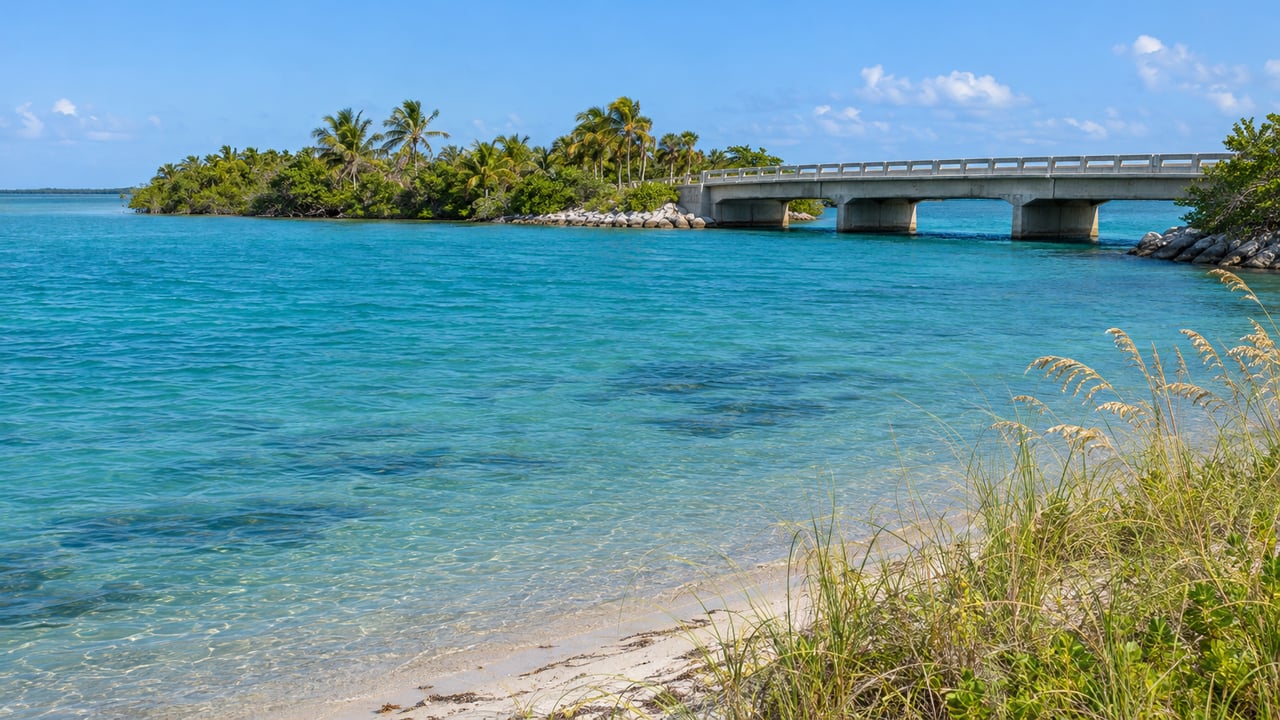
The federal government's navigation guide for this coast describes Boca Grande Bayou as a sheltered, landlocked lagoon. It also names Harbor Drive Waterway, which leads west from the bayou near its south entrance, and puts the Intracoastal Waterway's entry into Gasparilla Sound at about Mile 30. That guide is the NOAA Coast Pilot, and its chapter for this stretch of coast is dated Nov. 8, 2026.
That word "sheltered" matters once the weather turns.
Local guides say that once the cold fronts start, fish leave open water and gather in deep, protected places and along structure. On the bay side of the village, those conditions start at the seawall. The tarpon crowds have gone home, and the island's easiest winter fishing is often a few steps from the back door.
Late November is still the fall bite
The cold-weather pattern hasn't fully set in yet. Capt. Danny Latham's November 2026 fishing report found redfish scattered through Charlotte Harbor, Gasparilla Sound and Pine Island Sound, with live pinfish and sardines as the best baits. He expected the remaining schools to break up as the month went on. He reported snook moving back inshore toward mangrove shorelines and protected water, and a trout bite that improved with each cooler week, mostly on live sardines.
His report also says tarpon are still around this month on live ladyfish and pinfish, and that the cold fronts will eventually close that window. Nearshore, he was seeing plenty of Spanish mackerel, some tripletail and a few kingfish, and he expected each front to improve that bite.
A month earlier, Capt. Will Waterhouse told the Boca Beacon on Oct. 22 that snook, redfish and trout were chasing bait on the backcountry flats, schools of jacks were around, and artificials were producing action. Together, the two reports describe a fall that is still warm enough for fish to range widely and feed hard.
Water quality is clean for now. The Florida Fish and Wildlife Conservation Commission's red tide update of Nov. 13, 2026 says Karenia brevis was not observed in samples from or offshore of Lee County that week. No Charlotte County samples were analyzed that week. The agency's regional sample table records a "Not Present" result at Boca Grande Pass for a sample collected Nov. 5. That result covers one place on one day, and FWC updates the page weekly, so check it again before a trip.
What changes after the first real front
Capt. Van Hubbard described what happens next in a Boca Beacon column on Dec. 26, 2025. Colder temperatures push fish into deep, protected water. Deeper water takes longer to change temperature, so he goes deep during a cold front and moves back to the grass flats as the water warms. According to Hubbard, redfish and trout handle the cold better than most species. They school up in the deepest holes, while the shallow flats warm first and hold the food, so afternoons can be the best time to fish on cold days.
Hubbard also notes that north winds are cold and that taller trees and buildings can block them, and he adds that anglers will be more comfortable in the same places the fish prefer.
Cold fish move slowly, and Hubbard's advice is to slow down with them. He suggests slow retrieves for sluggish fish and a faster pace as the water warms. For trout, his favorite rig is a rattle cork over two feet of fluorocarbon, a quarter-ounce jig head and a live shrimp, twitched often.
On snook, Hubbard advises leaving them alone in cold water. Snook are subtropical fish that are already stressed by the cold, and he writes that fish that seem fine at release often die later from the added strain. Waterhouse saw the same pattern during a hard cold snap in January 2025. In his Boca Beacon report of Jan. 17, 2025, the flats had cooled, large speckled trout were active on slowly fished live or artificial bait, redfish were coming mostly on live bait, and the snook had gone quiet.
Sheepshead and the pilings
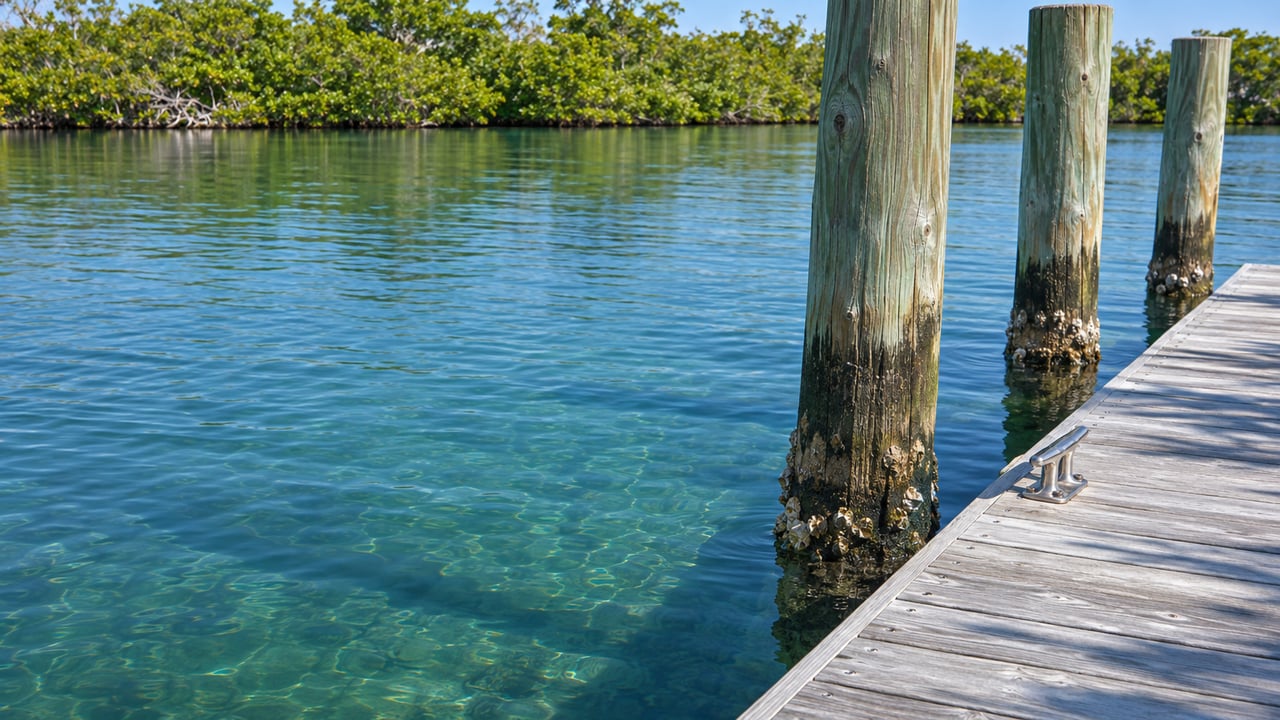
Sheepshead are the fish most closely tied to dock pilings in winter. Hubbard writes that sheepshead begin gathering as the water cools, first around food sources such as oyster bars and the edges of grass flats, and then on bridges, piers and other structure. Some redfish hang around the same structure, and flounder hold along its edges.
Sheepshead are also known as bait thieves. Hubbard prefers braided line for its sensitivity, with a short mono or fluorocarbon leader, 1 to 1/0 hooks and as little weight as possible. You need to feel the weight lift off the bottom and touch down again. If you can't feel that, he jokes, hope the flounder or drum are biting.
Latham's mid-November 2025 report described this shift a year ago. Sheepshead were starting their winter move onto docks, pilings and rocky structure, early pompano were showing along sandy drop-offs and channel edges near Boca Grande, and shrimp on jigheads were working for redfish and sheepshead around mangroves, oyster bars and docks. By late winter the sheepshead are plentiful. Hubbard's Boca Beacon column of Feb. 19, 2026 ran under the headline "Fish concentrate when chilly; sheepshead abundant for freezer." Regulations change, and Hubbard reminds readers to check Fish Rules for the current limits before keeping any fish.
Why the dock counts for more than it used to
For decades, fishing on Boca Grande in the cooler months included wading the shoreline. In a Boca Beacon column on Feb. 27, 2026, Capt. Joe LeClair wrote that walking the shoreline for snook, reds, trout, pompano, sheepshead, cobia and tripletail is now restricted to residents in many of the best areas, and that public access to key points in Placida and Boca Grande has been shrinking for years. Charlotte County's facilities status page lists the Boca Grande Fishing Pier as closed for restoration.
With fewer public places to fish, a private dock or seawall on the bay side is one of the most dependable winter spots on the island. The fish Hubbard and Latham describe for December through February are the same ones that hold on pilings and in sheltered, deep water: sheepshead, schooled redfish and trout, and flounder along the edges.
A practical note for anyone heading out by boat: the Coast Pilot's depth figures for the Boca Grande Bayou channels are old reports, a 6-foot controlling depth in 1982 for the main channel and 4 feet in 1986 for an alternate channel that was reported no longer maintained in 1999. The guide also cautions that channels can shoal several feet between dredgings and refers boaters to the Army Corps of Engineers for current controlling depths.
Bait, fuel and a guide within a short run
The closest stop sits on the same water. The Chamber lists Boca Grande Marina at 220 Harbor Drive South. The marina, formerly Miller's Marina, lists daily hours of 8 a.m. to 5 p.m. for the 2026/27 season, with diesel and non-ethanol fuel. Miller's Dockside, next to it, is listed as open daily and overlooks the marina basin. Eagle Grille is the evening restaurant at the same marina.
For a guide, Gasparilla Outfitters at 431 Park Avenue represents local fishing guides, and Capt. Sandy Melvin is its contact. The Boca Grande Chamber of Commerce's fishing guide directory lists Capt. Willie Mills at Whidden's Marina on First Street East.
The Chamber also lists Uncle Henry's Marina at 5820 Gasparilla Road on the island, and Gasparilla Marina across the causeway at 15001 Gasparilla Road in Placida. Gasparilla Marina's shop stocks frozen squid, rigged sardines, mullet and chum blocks. Charlotte County's Placida Park has a boat ramp and canoe and kayak access for guests who trailer a boat.
Taken together, the guides' reports describe the same winter progression. Through Thanksgiving, the redfish are still roaming, the trout are improving and the last tarpon are around. After the first hard front, fish slow down, gather in the deepest sheltered water, and the sheepshead move onto the pilings and stay through February. On Harbor Drive and the Waterways, that structure is often at the end of the yard. Our Harbor Drive and Waterways neighborhood guide covers more of the bayside, and our tarpon season guide covers the spring run that starts once winter ends.
A dock on the bayside is part of how a Harbor Drive or Waterways home gets used in every season, winter included. If you are curious how your home and its frontage compare in today's market, the Steffan Sieglaff Crawford Team is glad to talk it through with you. Start with How much is your home worth?